Posts

Showing posts with the label Roman Martyrology

St. Frumentius

Image
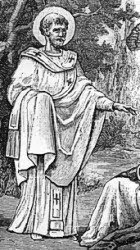
Saint Frumentius was the first Bishop of Axum, and he is credited with bringing Christianity to Aksumite Kingdom. He was a Syro-Phoenician Greek born in Tyre. According to the 4th century historian Rufinus (x.9), who cites Frumentius' brother Edesius as his authority, as children (ca. 316) Frumentius and Edesius accompanied their uncle Meropius on a voyage to Ethiopia. When their ship stopped at one of the harbors of the Red Sea, people of the neighborhood massacred the whole crew, with the exception of the two boys, who were taken as slaves to the King of Axum. The two boys soon gained the favour of the king, who raised them to positions of trust, and shortly before his death, gave them their liberty. The widowed queen, however, prevailed upon them to remain at the court and assist her in the education of the young heir, Ezana, and in the administration of the kingdom during the prince's minority. They remained and (especially Frumentius) used their influence to spread Christi...

Feast of the Most Holy Name of Mary

Image
Most Holy Name of Mary, Feast of the Holy Name of Mary, or simply Holy Name of Mary is a feast day in the Roman Catholic Church celebrated on 12 September to honour the name of Mary the mother of Jesus. It has been a universal Roman Rite feast since 1684, when Pope Innocent XI included it in the General Roman Calendar to commemorate the victory at the Battle of Vienna in 1683. The entry in the Roman Martyrology about the feast speaks of it in the following terms: The Holy Name of the Blessed Virgin Mary, a day on which the inexpressible love of the Mother of God for her Holy Child is recalled, and the eyes of the faithful are directed to the figure of the Mother of the Redeemer, for them to invoke with devotion. The feast day began in 1513 as a local celebration in Cuenca, Spain, celebrated on 15 September. In 1587 Pope Sixtus V moved the celebration to 17 September. Pope Gregory XV extended the celebration to the Archdiocese of Toledo in 1622. In 1666 the Discalced Carmelites received...

St. Raymond Nonnatus

Image
Born in the very beginning of the thirteenth century . Your name leaves gaping to anyone who hears or reads it first . Nonnatus - Nonnatus however brief , suggests a saint only potential , as if the word were an advertising slogan that was inviting to anyone who reads or hears it decided to start a program that would end the sanctity of the predetermined script . In fact , it means the unborn. " pretend that the strange name , was not born yet the saint who complete the full application of their qualities and virtues, is like expecting the Church to have one it decides when to reproduce ? That would , of course , to confuse holiness as something that springs from the will and human decision when she is actually the result of the action of the Holy Spirit who freely cooperates . It would simply Pelagianism. The term , which has already become -name Raymond comes to the fact that it was removed from the womb through surgery , when her mother died . Why was not born as children are b...

St. Silverius

Image
Dates of birth and death unknown. He was the son of Pope Hormisdas who had been married before becoming one of the highest clergy. Silverius entered the service of the Church and was subdeacon at Rome when the Pope Agapitus died in Constantinople on 22 April of the year 536.La Empress Theodora, who favored the Monophysite tried to induce the election as pope of the Roman deacon Vigilius who was then in Constantinople and had given the desired guarantees as to the Monophysite. However, Teodato, King of the Ostrogoths, who wanted to prevent the election of a pope connected to Constantinople, anticipate, and influence the subdeacon Silverio was chosen. The choice of a subdeacon as bishop of Rome was unusual. Consequently, it is easy to understand that, as the author of the first part of the life of Silverio in the "Liber Pontificalis" (ed. Duchesne, I, 210) recounts, appeared strong opposition among the clergy. This, however, was repressed by Teodato so finally, after Silverio h...

Saint Gondulphus of Berry

Saint Gondulphus of Berry who is honoured with the title of bishop, is a person of whom history gives a still more legendary account than of his namesake, Gondulf of Maastricht. According to the biography in which he is comparatively lately treated by a monk of Berry, he was Archbishop of Milan in the seventh century. Not succeeding in appeasing the troubles which had arisen in his church, he resolved to submit to the inevitable, and retired to Berry with a number of his disciples. It is not known, however, that any Archbishop of Milan had to deal with these conditions. It is true that it has been thought that Gondulphus lived at the time of the Milanese schism regarding the affair of the Three Chapters, that he was consecrated in 555, but that he was never received as bishop in his diocese. These are merely hypotheses and in fact it must be said that the history of the St. Gondulphus who is honoured in Berry is unknown. The attestation of his cult in Berry appears late among the addit...

St. Expeditus

Image
St. Expeditus was commander of a Roman legion and as such defended the Empire against the invasions of the barbarians. By becoming a Christian was martyred (possibly by the Emperor Diocletian) in Melitene, Armenia (now Malatya, Turkey). Along with him died his comrades in arms: Caio, Galatians, Hermogenes, and Rufus Aristonicus. Many other martyrs gave glory to God in his time, including St. Philomena and St. George. According to tradition, at the time of conversion, the devil came to him in the form of a crow shouted "cras, cras cras" (in Latin means "Tomorrow, Tomorrow, Tomorrow"). So trying to persuade him to leave his decision later as the devil knows that what is left for tomorrow is much chance of that is undone. But the raven tempting crushed Expedito promptly saying "Hodi, Hodi, Hodi!" (TODAY, TODAY, TODAY). Do not leave anything for tomorrow, from today I will be Christian. "Thus he became a soldier of Christ, since that time using his courag...

St. Marciana of Mauretania

Image
Saint Marciana, originating "Rusuccur (now Tigzirt) in Mauritania, left all the advantages valiantly attempting to go to the world locked in a cell in Caesarea and keep her virginity intact, under the gaze of God. However, she believed it was their duty to declare war on idolatry that then reigned in Africa. One day, in crossing the public square, could not bear to see displayed a statue of Diana and broke his head. The arrested, beaten with rods, and then condemned her to die in the amphitheater, torn by the teeth of wild beasts. As expected this last punishment, handed it to the gladiators for violating her chastity, but God did not allow this outrage. At the date of execution, Marciana was exposed first to a lion who did not do any harm, then a bull pounced on her and thrust his horns into the chest, which fell face down on the floor, almost without sense. Finally, a leopard and tore this torment expired. The manuscripts of the Acts do not agree on the date of martyrdom, Januar...