Thursday, October 28, 2010

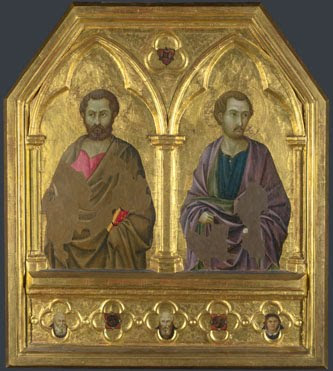
Ss. Simon and Jude


Simon belonged to the group formed in Israel. They were called the "zealots." Its purpose was to work hard against the Roman invasion in their country. However, listening to the word of Christ was for him the discovery of the universality of God's love.

Jude Thaddaeus has become one of the most popular saints for the favors given to people with regard to job search.
This devotion, and lived his life in St. Bridget. You can read in his book "Revelations" deep respect and devotion to this apostle of the first century of our era.

Why celebrate the holiday the same day?

The thing is simple. Tradition has it that the two were always together in a rich and fruitful apostolate. The Lord called him to complete the number of the twelve apostles, charged with being the continuers of the work of Jesus in the world.

Jude Thaddaeus called to distinguish it from other Judas Iscariot who betrayed, sold the Lord for thirty pieces of silver and then hanged himself.

Jude Thaddaeus wrote shortly. Only a letter from him is in the Bible. The purpose of the letter was a severe criticism against the Gnostic heresy that separates the physical from the spiritual. The physical or body is bad, and the spiritual is good. And both by emanations from God himself.

His letter ends with these words: "Be eternal glory to our Lord Jesus Christ who is able to keep us free from sin, and no stain on the soul and with great joy."

References: Catholic.Net

Wednesday, October 27, 2010

St. Frumentius


Saint Frumentius was the first Bishop of Axum, and he is credited with bringing Christianity to Aksumite Kingdom. He was a Syro-Phoenician Greek born in Tyre.

According to the 4th century historian Rufinus (x.9), who cites Frumentius' brother Edesius as his authority, as children (ca. 316) Frumentius and Edesius accompanied their uncle Meropius on a voyage to Ethiopia. When their ship stopped at one of the harbors of the Red Sea, people of the neighborhood massacred the whole crew, with the exception of the two boys, who were taken as slaves to the King of Axum. The two boys soon gained the favour of the king, who raised them to positions of trust, and shortly before his death, gave them their liberty. The widowed queen, however, prevailed upon them to remain at the court and assist her in the education of the young heir, Ezana, and in the administration of the kingdom during the prince's minority. They remained and (especially Frumentius) used their influence to spread Christianity. First they encouraged the Christian merchants present in the country to practise their faith openly; later they also converted some of the natives.

When Ezana came of age, Edesius returned to Tyre, where he stayed and was ordained a priest. Frumentius, on the other hand, eager for the conversion of Ethiopia, accompanied Edesius as far as Alexandria, where he requested Athanasius, Patriarch of Alexandria, to send a bishop and some priests to Ethiopia. By Athanasius' own account (Athanasius, Epistola ad Constantinum), he believed Frumentius the most suitable person for the job and consecrated him as bishop, traditionally in the year 328, or according to others, between 340-346. Frumentius returned to Ethiopia, erected his episcopal see at Axum, baptized King Ezana, who had meanwhile succeeded to the throne, built many churches, and spread Christianity throughout Ethiopia. The people called Frumentius Kesate Birhan (Revealer of Light) and Abba Salama (Father of Peace), and he became the first Abune — a title given to the head of the Ethiopian Church.

A letter exists from the Emperor Constantius II to King Ezana and his brother Saizanas, in which he vainly requested them to substitute the Arian bishop Theophilus for Frumentius.

The 2004 edition of the "Roman Martyrology" succinctly states, "In Aethiopia, sancti Frumentii, episcopi, qui, primum ibi captivus, deinde, episcopus a sancto Athanasio ordinatus, Evangelium in ea regione propagavit [In Ethiopia, (the feast) of Saint Frumentius, bishop, who first was a captive there, and then, as a bishop ordained by Saint Athanasius, he spread the Gospel in that region]."

References: Wikipedia.Org

Tuesday, October 26, 2010

St. Fulk of Pavia


Fulk of Pavia was born at Piacenza, Italy in 1164 and died 1229. Fulk's parents were Scottish. He was appointed to a canonry in Piacenza. Then, after his studies in Paris, he became archpriest and bishop of Piacenza.

Six years later he was transferred by Honorius III to the see of Pavia, which he occupied for 13 years. He was cannonised and his feast day is 26 October.

Monday, October 25, 2010

Ss. Crispin and Crispinian


The soul that wants to give himself entirely to God, not seeking anything for himself but to think, speak and act with the goal of God. And this is no bigotry, but a strong and intense drive to do enough for others.

Today's youth, who died in 285, are far from our history of the third millennium.

However, their works and their names are etched in the pages of the history of the Church forever.

Who were they?, What did?

They settled in Rome and learned the trade of shoemakers. And any work can make an announcement or proclamation of the Gospel and the riches it brings to the human soul.

This service is finalized to make shoes for the poor. These, of course, not charged them anything.

The rich, who knew the good job they did and the quality of the shoe, it charged them.

The beauty of these two believers is engaging the time of sale or free to speak enthusiastically about Jesus Christ.

And the most natural thing in the world.
Should live what they said because people heard gladly.

The French say they lived in the region of Soissons. The British, in turn, say they lived in the county of Kent, southern England.

Shakespeare's praises in his play "Henry V" and "Julius Caesar."

As everyone agrees on is that died as martyrs.

References: Catholic.Net

Sunday, October 24, 2010

St. Anthony Mary Claret


Anthony Claret was born on December 23, 1807, is Sallent, Spain, the fifth child of John Claret and Josephine Clara.

Anthony's vocation to the Priesthood became evident at a very tender age. However, the financial circumstances of the family made it necessary for him to spend his early youth helping his father in the weaver's shop. When his help was no longer an absolute necessity in the home "the weaver's son" entered the Seminary in Vich, and was raised in the Holy Priesthood on June, 13, 1835.

The activities of the ministry in a small-town parish were unable to satisfy the yearnings of Claret's great soul. He preached first in his own Diocese and later, at the invitation of the other Bishops, he covered all of Spain and the Canary Islands. He is also known to have many a time delivered as many as eight sermons in one day and often to have heard confessions for ten solid hours without interruption.

Everywhere he went miracles of conversion were recorded and the faithful returned to a fervent militant practice of the Catholic Faith. People soon began to look to him not only for spiritual help but also for relief of their physical ills. When his personal efforts became insufficient for the task on hand he called on the assistance of other apostolic men and founded the Congregation of Missionary Sons of the Immaculate Heart of Mary (Claretian Fathers) on July 16, 1849.

The Holy Father being well aware of Father Claret's apostolic dynamism considered him the ideal Pastor for the very difficult vacant See of Santiago in Cuba and appointed him its Archbishop. He was consecrated on October 6, 1850, taking for his motto "The Charity of Christ urgeth us on," adding the name of Mary to his own.

The first official act of the new Archbishop was to consecrate his diocese to the Immaculate Heart of Mary. He then began the systematic reconstruction of the Diocese by personally conducting retreats for all the Clergy, and his missions for the faithful of the extensive and extremely difficult territory. He instituted a Seminary for native clergy and founded an order of teaching Sisters. He published a simple illustrated catechism and devised a system for teaching religion which was later approved by the Vatican Council for the entire Church. He established cooperative Farms, Parish Credit Unions, a Boys' Town and Girls' Town, and founded the first institute of "Religious in their homes" or what are now known as Secular Institutes. He fought the injustices of wealthy European land owners, going as high as Her Majesty's government in Spain in his efforts to defend the rights of the working classes.

Queen Isabella II, the reigning sovereign in Spain, became deeply interested in the work and philosophy of the saintly Archbishop of Santiago. Wishing to see the impact of his apostolate and the influence of his holiness felt throughout her entire Realm she prevailed on the Holy Father, Pope Pius IX, to appoint him her confessor and spiritual director of the Royal Household in 1857.

It was during this period that the forces of irreligion unleashed their bitter attacks upon the Holy Archbishop and all he stood for. Every available means was used to discredit his name, and render him inactive. His enemies rested only when they had succeeded in having him banished from the country. And even then, their relentless persecution followed him into exile.

From his exile in Paris, the Archbishop traveled to Rome for the Vatican Council, at which he took a very active part. While in Rome, the Archbishop suffered a severe stroke of apoplexy and was moved back to France. He went to his reward in the Cistercian Monastery of Fontifroid on October 24, 1870.

At the present time, devotion to Saint Anthony Mary Claret is rapidly spreading throughout the world, and especially here in America.

Saturday, October 23, 2010

St. John of Capistrano


Born in Capistrano, diocese of Sulmona, Italy, in 1385.
The son of a French or German gentleman who died when John was young.
Carefully studied at the University of Perugia (near Assisi).
He was a lawyer and judge. In 1412 he was appointed governor of Perugia by Landislaus king of Naples, who had control of that city. He fought against corruption and bribery.

When war broke out between Perugia and Malatesta in 1416, John tries to make peace, but instead was taken prisoner of war. In prison he decided to give himself entirely to God. Had a dream that San Francisco saw that he was called to enter the Franciscan order. John had married just before being taken prisoner, but the marriage never ate and was annulled.

He entered the Franciscan order in Perugia on October 4, 1416. He was 30 years, so the novice tested it by giving the most humble offices.

He was a disciple of St. Bernardino of Siena who taught him theology. He distinguished himself as a preacher while being a deacon. Ordained at age 33. For 40 years he was an itinerant preacher in Italy and other countries. Once in Brescia (Italy) preached to a crowd of 126,000 people who had come from neighboring provinces. For his radical call to conversion and simplicity, people connected to San Juan Bautista. They brought the stuff of superstition and the occult and burned in public bonfires. He was renowned for his gift of healing and bring him to the sick so that they make the sign of the cross. As San Bernardino, spread devotion to the name of Jesus, so both, along with other Franciscans, were accused of heresy. The group successfully defended.

Many young people followed him to the religious life. Established Franciscan communities. He wrote extensively, mainly against the heresies of his day. Many of his sermons are preserved.

He slept and ate little. Doing penance.

Franciscan community twice elected him vicar general. In a visit to France met St. Colette, reformer of the Order of St. Clare, with whom he sympathized.

John had a great gift for diplomacy. He was wise and prudent measure their words knowing that they serve the will of God. Four Popes (Martin V, Eugene IV, Nicholas V and Calixtus III) employed him as ambassador to many very delicate diplomatic missions with very good results. Three times they offered him appointed bishop of major cities but chose to remain a poor preacher.

He was papal nuncio in Austria where he preached extensively and fought the heresy of the Hussites. He also preached with great fruit in Poland, invited by Casimir IV.

The Crusaders defend Europe

In 1451 the Sultan Mohammed II launched a campaign to achieve the conquest of Europe. Conquered Constantinople in 1453 and then prepared to invade Hungary. In 1454 Servia fell into his hands. News from Serbia were horrible, who refused to renounce Christ were tortured. All that was Christian was destroyed or confiscated.

In 1454 Juan Capistrano participated in the diet of Frankfort and started to prepare the defense of Hungary. Went to Hungary, and preached a crusade in defense of Christianity. At the age of 70 years the Pope Callistus II commissioned him to direct. In Szeged joined the army of peasants who had joined the army of Hunyady and they went to Belgrade. It was said that the barracks seemed more religious houses that military camps because they prayed and preached the virtue. Mass is celebrated daily. A Juan Capistrano you had a great respect.

Battle of Belgrade, 1456, save Europe from the Muslims.

The Muslims attacked Belgrade had 200 guns, 50,000 cavalry and a large fleet that entered the river Danube. Given the superiority of enemy forces, the Christians thought retire. But Juan Capistrano intervened Hunyady convincing to attack the Turkish fleet despite being much larger. By the time the defenders of the city would withdraw giving up, being encouraged John in his hands a flag with the cross and shouting incessantly: "Jesus, Jesus, Jesus." Through all the battalions shouting enthusiastically: "Brave Believers, all to defend our holy religion." John never used the weapons of this world but the prayer, penance and preaching.

While fighting in Belgrade, the Pope asked to pray the Angelus for the win. The Muslims were defeated and had to withdraw from the region. This won the battle of Belgrade on 21-22 July 1456.

St. John of Capistrano had offered his life to God to save Christianity. God accepted his offer and soon died with Hunyady victims of typhus. The bodies of those killed in battle led to a typhus epidemic also spread to the saint who was already weak and elderly. He died in Villach, Hungary, a few months later, on 23 October.

In America his name is famous for the Franciscan mission in California that bears his name.

Beatified: December 19, 1650 by Innocent X
Canonized: October 16, 1690 by Alexander VIII

References: Catholic.Net

Friday, October 22, 2010

St. Donatus of Fiesole


Donatus was born in Ireland, of a noble family. He was educated at Inis Cealtra on Lough Derg. About 816 he visited the tombs of the Apostles in Rome with his friend, Andrew the Scot. According to Christian tradition, on his journey northwards he was led by Divine Providence to the cathedral of Fiesole, which he entered at the moment when the people were grouped around their altars praying for a bishop to deliver them from temporal and spiritual evils. Raised by popular acclaim to the See of Fiesole, Donatus instituted a revival of piety and learning in the church over which he was placed. Donatus made Andrew his deacon.

He himself did not disdain to teach "the art of metrical composition". The "Life" is interspersed with short poems written by the saintly bishop. The best known of these is the twelve-line poem in which he describes the beauty and fertility of his native land, and the prowess and piety of its inhabitants. Donatus also composed an epitaph in which he alludes to his birth in Ireland, his years in the service of the princes of Italy (Lothair and Louis), his episcopate at Fiesole, and his activity as a teacher of grammar and poetry.