Posts

Showing posts with the label Mother of Christ

The Assumption of the Virgin Mary

Image
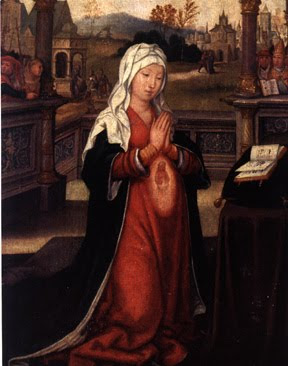
The Feast of the Assumption The Feast of the Assumption of the Blessed Virgin Mary, 15 August; also called in old liturgical books Pausatio , Nativitas (for heaven ), Mors , Depositio , Dormitio S. Mariae . This feast has a double object: (1) the happy departure of Mary from this life ; (2) the assumption of her body into heaven. It is the principal feast of the Blessed Virgin. THE FACT OF THE ASSUMPTION Regarding the day, year, and manner of Our Lady's death, nothing certain is known. The earliest known literary reference to the Assumption is found in the Greek work De Obitu S. Dominae . Catholic faith, however, has always derived our knowledge of the mystery from Apostolic Tradition. Epiphanius (d. 403) acknowledged that he knew nothing definite about it (Haer., lxxix, 11). The dates assigned for it vary between three and fifteen years after Christ's Ascension. Two cities claim to be the place of her departure: Jerusalem and Ephesus. Common consent favours Jerusalem, where he...
Our Lady of Perpetual Help

Image
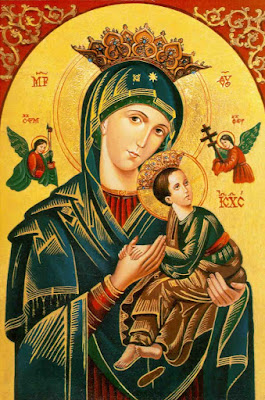
In 1498, the picture of Our Lady of Perpetual Help was in a church on the island of Crete, in Greece. The picture had been there for some time and was known to be miraculous. One day a merchant from Crete stole the picture of Our Lady. He hid the picture among his things, boarded a ship and set out to sea. When a great storm arose the terrified sailors begged God and Our Lady to save them. Their prayers were heard and they were saved from shipwreck. A year later, the merchant went to Rome with the picture. There he got a disease and became terribly sick. He asked his Roman friend to take care of him. The merchant grew worse and realized that he would soon die. He called on his friend and with tears in his eyes, begged his friend to do him one last favour. When the Roman promised to do so, the weeping merchant continued, “Some time ago I stole a beautiful, miraculous picture of Our Lady from a church in Crete! You will find it with my belongings. I beg you, please place it ...

Our Lady of Good Counsel

Image
The story of how the miraculous fresco of Our Lady of Good Counsel left Albania and traveled to Italy is one that is marvelous and true. There is a little town, about 25 miles outside of Rome, called Genazzano. In pagan times it was a celebrated shrine for the worship of Venus, but in the fourth century a church was built there in honor of Our Lady and called the Church of the Virgin Mother of Good Counsel. Through the course of time the church was abandoned and almost fell into ruins. So it remained until the mid 15th century when a pious woman gave all she had for its restoration. This story is about that pious woman, who in many ways is a symbol for our times. Most of the time her name is lost in the marvel of the facts of the story. She is simply recorded as a pious widow, a tertiary of the Order of St. Augustine, and perhaps she would have it that way. But it seems to me that the story and the miracle of image of Our Lady of Good Counsel of Genazzano is in a special way her story,...

Immaculate Conception

Image
In the eighth century it became a feast of the Roman Catholic Church. It is the only one of Mary's feasts that came to the Western Church not by way of Rome, but instead spread from the Byzantine area to Naples and then to Normandy during their period of dominance over southern Italy. From there it spread into England, France, Germany, and eventually Rome. Prior to Pope Pius IX's definition of the Immaculate Conception as a Roman Catholic dogma in 1854, most missals referred to it as the Feast of the Conception of the Blessed Virgin Mary. The festal texts of this period focused more on the action of her conception than on the theological question of her preservation from original sin. A missal published in England in 1806 indicates the same collect for the feast of the Nativity of the Blessed Virgin Mary was used for this feast as well. The first move towards describing Mary's conception as "immaculate" came in the eleventh century. In the fifteenth century Pope S...