Posts

Showing posts with the label Catholism

The Dedication Of The Basilica Of St. John Lateran

Image
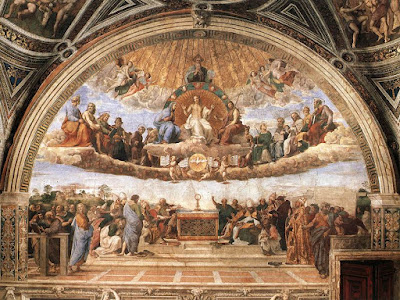
The anniversary of the dedication of the Lateran Basilica, which was erected by Emperor Constantine, has been observed on this day since the Twelfth Century. This feast was at first observed only in Rome but later in honor of the basilica, which is called the mother church of Christendom, the celebration was extended to the whole Latin Church. This action was taken as a sign of devotion to and of unity with the Chair of Peter which, as Saint Ignatius of Antioch wrote, "presides over the whole assembly of charity." This Basilica is know for its many different works of art. It is known to have many Papal tombs/remains, but it also holds St. Helen's remains in a sarcophagus. By decree of Pope Clement XI the basilica added all 12 apostles made by 7 different artist. Prayer Father, Each year we recall the dedication of this church to your service. Let our worship, always be sincere and help us to find your saving love in this church. Grant this through Christ our Lord. AMEN .
St. Leonard of Noblac

Image
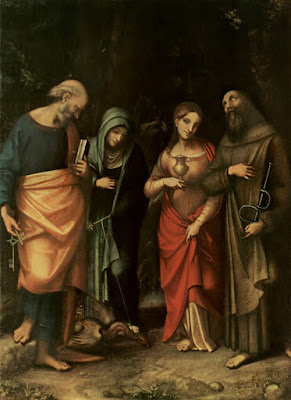
(from left to right: St. Peter, St. Martha, St. Mary Magdalene, and St. Leonard) St. Leonard was born in France sometime during the 5th century and died in the half way through the 6th century. He was part of the nobelman of King Clovis I. A Frankish noble, Leonard was converted by Remigius, bishop of Rheims in the 6th century. Through this Clovis he was able to liberate many of the prisoners. He then became a hermit in Noblac in the forest of Limousin where he made a cell for himself. One day Clovis and his pregnant wife were out hunting, and through the prayers of St. Leonard she gave birth in his hermitage cell. To this Clovis was very greatful, to the extent of giving him the land surrounding the area to build a monastery. According to legend, prisoners who invoked him from their cells saw their chains break before their eyes. Many came to him afterwards, bringing their heavy chains and irons to offer them in homage. A considerable number remained with him, and he often gave them p...

St. Charles Borromeo

Image
Charles was born in Arona, Italy in 1538. He came from a very renowned family the Borromeo Family, his father was the count of the region and his mother was the sister of Pope Pius IV, meaning he was the nephew of the Pope. When Borromeo was about twelve years old, his uncle Giulio Cesare Borromeo, resigned to him an abbacy, during this time he studied the charity towards the poor. He studied the civil and canon law at Pavia. In 1554 his father died, and although he had an elder brother, Count Federigo, he was requested by the family to take the management of their domestic affairs. After a time, he resumed his studies, and in 1559 he took his doctoral degree. In 1560 his uncle, Cardinal Angelo de' Medici, was raised to the pontificate as Pope Pius IV. Pope Pius IV then named Borromeo to the post of Cardinal of Romagna and the March of Ancona, and supervisor of the Franciscans, Carmelites and Knights of Malta. Borromeo declined the proposal. He worked even harder for the welfare of...

St. Martin de Porres

Image
St. Martin was born as Juan Martin De Porres, who was born in Lima, Peru on December 9th in 1579, and was also the illegitimate son to Spanish nobleman and a black slave. He grew up in poverty; when his mother could not support him and his sister, Martin was confided to a primary school for two years, then placed with a barber/surgeon to learn the medical arts. This caused him great joy, though he was only ten years old, for he could exercise charity to his neighbor while earning his living. Already he was spending hours of the night in prayer, a practice which increased rather than diminished as he grew older. Until his death he would flagellate himself three times every night, for his own failings and for the conversion of pagans and sinners. At the age of 15 he asked for admission to the Dominican Convent of the Rosary in Lima and was received first part of their Third Order. His piety and miraculous cures led his superiors to drop the racial limits on admission to the Order, and he...

All Saints Day

Image
The origin of the festival of All Saints celebrated in the West dates to May 13, 609 or 610, when Pope Boniface IV consecrated the Pantheon at Rome to the Blessed Virgin and all the martyrs; the feast of the dedicatio Sanctae Mariae ad Martyres has been celebrated at Rome ever since. The chosen day, May 13, was a pagan observation of great antiquity, the culmination of three days of the Feast of the Lemures, in which the malevolent and restless spirits of the dead were propitiated. Liturgiologists of the Middle Ages based the idea that this Lemuria festival was the origin of that of All Saints on their identical dates and on the similar theme of "all the dead". The feast of All Saints, on its current date, is traced to the foundation by Pope Gregory III of an oratory in St. Peter's for the relics "of the holy apostles and of all saints, martyrs and confessors, of all the just made perfect who are at rest throughout the world", with the day moved to November 1. I...