Posts

Showing posts with the label Sainthood

St. Jean de Brébeuf

Image
He is the patron of the Jesuits in Canada and one of the most notable missionaries of the Society of Jesus. Home birth John was born on March 25, 1593, in Condé sur Vire, in Normandy eastern France. Belongs to a family of landowners and farmers. His parents are rich, and well regarded within its class, and throughout the region. Catholics are committed, despite the prevailing Calvinism of Normandy. Its formation The school teacher, or perhaps the priest of the parish of Condé sur Vire, taught to read and write. Due to the position of the family, John is studying at the Academy after the nearby town of Saint Lô. Later starts the humanistic studies at the University of Caen. With the Jesuits Jean de Brébeuf is 16 years old when the Jesuits opened a college in the city of Caen. The falls there to the study of philosophy. The school is closed the following year, in 1610, but the Jesuits maintained a residence in the city. John continues under the spiritual guidance of his former teachers. ...
St. Euphemia

Image
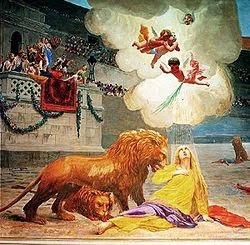
St. Euphemia was the daughter of a respectable man of Chalcedon , near Constantinople. At the time of Diocletian , was captured, tortured and finally thrown to the lions. Usually it is represented with the palm of martyrdom , the wheel and beside it, one or more lions. Devout Christians recovered his body and took him to Constantinople where the Emperor Constantine had built a church in her honor. His sarcophagus remained there until they reached the iconoclasts , at 800 . According to tradition, a stormy night , the coffin disappeared from Constantinople, and July 13 of 800 reached the coast of Rovinj. He was picked up by a young man who , by dragging it with the help of two horses , took him to the church of San Francisco. The appearance of the sarcophagus was considered miraculous , so that people began to venerate the saint as their patron saint . The sarcophagus dates from the third century, is of marble, but is not finished. Has about 208 cm . long, 195 cm. high and 95 cm wide. I...

Pope St. Pius X

Image
On June 2, 1835, Giuseppe Melchiorre Sarto saw the light of earth at Riesi, Province of Treviso, in Venice; on August 20, 1914, he saw the light of heaven; and on May 29, 1954, he who had become the two hundred fifty-ninth pope was canonized St. Pius X. Two of the most outstanding accomplishments of this saintly Pope were the inauguration of the liturgical renewal and the restoration of frequent communion from childhood. He also waged an unwavering war against the heresy and evils of Modernism, gave great impetus to biblical studies, and brought about the codification of Canon Law. His overriding concern was to renew all things in Christ. Above all, his holiness shone forth conspicuously. From St. Pius X we learn again that "the folly of the Cross", simplicity of life, and humility of heart are still the highest wisdom and the indispensable conditions of a perfect Christian life, for they are the very source of all apostolic fruitfulness. His last will and testament bears the...

St. John Eudes

Image
John Eudes was born at Ri, Normandy, France, on November 14, 1601, the son of a farmer. He went to the Jesuit college at Caen when he was 14, and despite his parents' wish that he marry, joined the Congregation of the Oratory of France in 1623. He studied at Paris and at Aubervilliers, was ordained in 1625, and worked as a volunteer, caring for the victims of the plagues that struck Normandy in 1625 and 1631, and spent the next decade giving Missions, building a reputation as an outstanding preacher and confessor and for his opposition to Jansenism. He became interested in helping fallen women, and in 1641, with Madeleine Lamy, founded a refuge for them in Caen under the direction of the Visitandines. He resigned from the Oratorians in 1643 and founded the Congregation of Jesus and Mary (the Eudists) at Caen, composed of secular priests not bound by vows but dedicated to upgrading the clergy by establishing effective seminaries and to preaching missions. His foundation was opposed ...

St. Cassian of Imola

Image
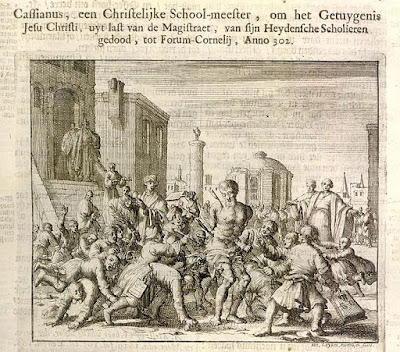
One day the poet Aurelio Prudencio went to Rome . It is in the early fifth century On his way to the imperial capital stops at the Forum Cornelius, Imola today . Take a heavy heart , because the solution of business, purpose of travel , perhaps depends the security of your future and your family. profoundly Christian spirit , is urged to commend the Redeemer and goes to pray in a church. Kneels before the tomb of the martyr Cassian, whose relics are venerated there, and sinks into deep prayer. A prayer is a count contrite sins and sufferings. When , in tears, he lifts his eyes to heaven , his eye is caught in the contemplation of a painting of vivid colors. We see in him the image of a naked man , covered with wounds and blood, his skin torn by a thousand sites. In a crowd of kids around wield against him exalted school instruments and strive to stab him in the flesh lacerated and stilettos used to write. Moved by this tragic poet pictorial vision , which certainly is a move of its own...

St. Silverius

Image
Dates of birth and death unknown. He was the son of Pope Hormisdas who had been married before becoming one of the highest clergy. Silverius entered the service of the Church and was subdeacon at Rome when the Pope Agapitus died in Constantinople on 22 April of the year 536.La Empress Theodora, who favored the Monophysite tried to induce the election as pope of the Roman deacon Vigilius who was then in Constantinople and had given the desired guarantees as to the Monophysite. However, Teodato, King of the Ostrogoths, who wanted to prevent the election of a pope connected to Constantinople, anticipate, and influence the subdeacon Silverio was chosen. The choice of a subdeacon as bishop of Rome was unusual. Consequently, it is easy to understand that, as the author of the first part of the life of Silverio in the "Liber Pontificalis" (ed. Duchesne, I, 210) recounts, appeared strong opposition among the clergy. This, however, was repressed by Teodato so finally, after Silverio h...

St. John of Sahagun

Image
John Gonzales de Castrillo was born at Sahagun, Leon Spain. He was educated by the Benedictine monks of Fagondez monastery there and when twenty, received a canonry from the bishop of Burgos, though he already had several benefices. He was ordained in 1445; concerned about the evil of pluralism, he resigned all his benefices except that of St. Agatha in Burgos. He spent the next four years studying at the University of Salamanca and then began to preach. In the next decade he achieved a great reputation as a preacher and spiritual director, but after recovering after a serious operation, became an Augustinian friar in 1463 and was professed the following year. He served as master of novices, definitor, prior at Salamanca, experienced visions, was famous for his miracles, and had the gift of reading men's souls. He denounced evil in high places and several attempts were made on his life. He died at Sahagun on June 11, reportedly poisoned by the mistress of a man he had convinced to ...

St. Landericus

St. Landericus (or Landry) was a sincere and dedicated servant of God who, like his Lord Jesus Christ, had great love for the poor and the lowly. As Bishop of Paris, from 650-661, he labored zealously to improve their lot. And when the proceeds from the sale of all his possessions did not suffice to relieve their hungry during a famine, he went so far as to sell some of the Church vessels and furniture. St. Landericus became increasingly aware that the sick poor of his diocese were not really cared for by the custom then in vogue of housing them in little hostels dependent on the casual alms of charitable persons. This led him to erect the city's first real hospital, dedicated to St. Christopher, which in time became the famous Hotel-Dieu. Always on the alert to provide spiritual help for his people, this saintly bishop welcomed the Benedictines into his diocese and encouraged them to set up the Abbey of Denis. In 653, in company with twenty-three other bishops, he signed the found...

St. Paternus of Avranches

Image
Saint Paternus of Avranches in Normandy (c. 482-565) was born around the year 482, although the exact year is unknown, in Poitiers, Poitou. He was born into a Christian family. His father Patranus went to Ireland to spend his days as a hermit in holy solitude. Because of this, Paternus embraced religious life. He became a monk at the Abbey of Marnes in France. Later on, St Paternus went to Wales where he built a monastery called Llanpatenvaur.Before long, he wished to attain the perfection of Christian virtue by a life of penance in solitude. He went into solitude with his fellow monk, Saint Scubilion. The forest of Seicy in the diocese of Coutances was the place he became a hermit. At a later date, the abbot of the region who knew Paternus recommended him to the Bishop of Coutances and the bishop made him a priest in 512. Together with St Scubilion he evangelized the western coasts and established several monasteries of which he was made the abbot general. Prayer Father may we follow ...

St. Waldetrudis

Image
Saint Waltrude is the patron saint of Mons, Belgium, where she is known in French as Sainte Waudru, and of Herentals, Belgium, where she is known in Dutch as Sint-. Both cities boast a large medieval church that bears her name. Married to the Count of Hainault, she raised four children. After her husband retired to an abbey, she herself became a nun in 656. She founded her own convent and the city of Mons grew around it. The shrine of Saint Waltrude is kept in the collegiate church dedicated to her in Mons. Each year as part of the Ducasse de Mons festival, the shrine is placed on the car d'or, a gilded cart, and drawn by horses through the city streets. She died April 9, c. 688 AD. This is all that is known ab out this Saint. Prayer Father may the life of St. Waldetrudishelp us become better Christians so we can love Christ,Virgin Mary,abd the Blessed Sacrament more each and every day. AMEN References: Wikipedia.Org

St. Lea

Image
A letter which St. Jerome wrote to St. Marcella provides the only information we have about St. Lea, a devout fourth century widow. Upon the death of her husband, she retired to a Roman monastery and ultimately became its Superior. Since his correspondence was acquainted with the details of St. Lea's life, St. Jerome omitted these in his letter. He concentrated instead on the fate of St. Lea in comparison with that of a consul who had recently died. "Who will praise the blessed Lea as she deserves? She renounced painting her face and adorning her head with shining pearls. She exchanged her rich attire for sackcloth, and ceased to command others in order to obey all. She dwelt in a corner with a few bits of furniture; she spent her nights in prayer, and instructed her companions through her example rather than through protests and speeches. And she looked forward to her arrival in heaven in order to receive her recompense for the virtues which she practiced on earth. "So i...

Saint Mutien-Marie Wiaux

Image
Saint Mutien-Marie Wiaux was a Belgian member of the Brothers of Christian Schools. He was born Louis Wiaux, the third of six children, in French-speaking Belgium to a devout Catholic family. After joining the Christian Brothers, he took the religious name Mutien-Marie, "Mutien" being a reference to the early Roman martyr Mucian. He began the novitiate at Namur. After teaching at an elementary school, he was assigned to teach at a boarding school, where he taught fine arts, including music and art, for fifty-eight years. At first teaching was a difficult assignment for him, and his students were known as disruptive and out of control. But in time Brother Mutien grew into an effective teacher also known for his patience and piety. He taught music and art, a saint of sensibility not intellect. Mutien-Marie was buried in Malonne. His fame began to grow after his death and miracles were attributed to him. Prayer Lord bless us with the memory of your humble servant Mutien-Marie, s...

St. Fursey

Image
Irish monastic founder, the brother of Sts. Foillan and Ulan, praised by St. Bede. Fursey was born on the island of Inisguia en Lough Carri, Ire­land, as a noble. He founded Rathmat Abbey, now probably Killursa. In 630 Fursey and his friends went to East Anglia, England, where he founded a monastery near Ugremouth on land donated by King Sigebert. In his later years, Fursey went to France to build a monastery at Lagny, near Paris, France. He was buried in Picardy. St. Bede and others wrote about Fursey’s intense ecstasies. Prayer of St. Fursey “The arms of God be around my shoulders, The touch of the Holy Spirit upon my head, The sign of Christ’s cross upon my forehead, The sound of the Holy Spirit in my ears, The fragrance of the Holy Spirit in my nostrils, The vision of heaven in my eyes, The conversation of heaven’s company on my lips, The work of God’s church with my hands, The service of God and my neighbour in my feet, A home for God in my heart, And to God, the father of all, my...

St. Martin of Leon

Image
Martin was a Canon Regular of the Augustinian Order. After the death of his mother, his father, Juan, decided to join the catholic Canonry at St. Marcellinus in León. Martin was educated and raised at the Canonry, and after the death of his father he decieded to go on a major pilgramage to many Italian cities and Constantinople. After he returned to Spain he decieded to take the habit of the Augustinian order, at St. Marcellinus, but after seeing this monastery had been secularized by the bishops he entered the collegiate church of St. Isidore in the same city. Martin distinguished himself by his zealous observance, his charity, and his deep devotion to the Blessed Sacrament. The religious of St. Isidore's dedicated a chapel to Martin very early and celebrated his feast each year. St. Martin wrote many commentaries to the Epistles and on the Book of Revelations. St. Martin has left full class discussions which are stored and were published by Espinosa in Seville. PRAYER Lord you le...

St. Genevieve

Image
St. Genevieve was born about the year 422, at Nanterre near Paris. She was seven years old when St. Germain of Auxerre came to her native village on his way to great Britain to combat the heresy of Pelagius. The child stood in the midst of a crowd gathered around the man of God, who singled her out and foretold her future sanctity. At her desire the holy Bishop led her to a church, accompanied by all the faithful, and consecrated her to God as a virgin. When Attila was reported to be marching on Paris, the inhabitants of the city prepared to evacuate, but St. Genevieve persuaded them to avert the scourge by fasting and prayer, assuring them of the protection of Heaven. The event verified the prediction, for the barbarian suddenly changed the course of his march. The life of St. Genevieve was one of great austerity, constant prayer, and works of charity. She died in the year 512. Her feast day is January 3rd. She dressed in a long flowing gown with a mantle covering her shoulders, simil...

St. Dominic of Silos

Image
Benedictine abbot and defender of the faith. Born in Canas, Navarre, Spain, circa 1000, he entered the Benedictines at San Millan de Ia Cogolla. King Garcia III of Navarre challenged him when he became abbot of the monastery, and Dominic refused to surrender part of the Benedictine lands to the crown. For this he was exiled, going to King Ferdinand I of Castile and Leon, who made him abbot of St. Sebastian Abbey at Silos, now called St. Dominic’s. Dominic reformed the abbey, built the cloisters in Romanesque style, and started a scriptorium that became famous throughout the region. One of the most beloved saints in Spain, Dominic also rescued Christian slaves from the Moors. Dominic’s shrine is noted for its place in the birth of Dominic de Guzman, the founder of the Order of Preachers. Dominic de Guzman’s mother begged for a child there. Dominic was also noted for miracles of healing. Prayer Lord may the memory of St. Dominic of Silos be an example, so that we too may live a life of s...

Saint Nicholas

Image
St. Nicholas, called "of Bari", Bishop of Myra (Fourth Century) 6 Dec. Feast day. The great veneration with which this saint has been honored for many ages and the number of altars and churches which have been everywhere dedicated in his memory are testimonials to his holiness and of the glory which he enjoys with God. He is said to have been born at Patara in Lycia, a province of Asia Minor. Myra, the capital, not far from the sea, was an episcopal see, and this church falling vacant, the holy Nicholas was chosen bishop, and in that station became famous by his extraordinary piety and zeal and many astonishing miracles. The Greek histories of his life agree that he suffered imprisonment of the faith and made a glorious confession in the latter part of the persecution raised by Dioletian, and that he was present at the Council of Nicaea and there condemned Arianism. The silence of other authors makes many justly suspect these circumstances. He died at Myra, and was buried in ...

St. John Berchmans

Image
St. John Berchmans was born the eldest son of a shoemaker in 1599 at Diest, Belgium. At a very young age he wanted to be a priest, and when thirteen he became a servant in the household of one of the cathedral canons at Malines. After his mother's death, his father and two brothers followed suit and entered religious life. In 1615 he entered the Jesuit college there, becoming a novice a year later. In 1618 he was sent to Rome for more study and was known for his diligence and piety, and his stress on perfection even in small things. That year his father was ordained and died six months later. John was so poor and humble that he walked from Antwerp to Rome. He died at the age of 22 on August 13. Many miracles were attributed to him after his death; he was canonized in 1888 and is the patron saint of altar boys. Although he longed to work in the mission fields of China, he did not live long enough to permit it. After completing his course work, he was asked to defend the "enti...