Posts

Showing posts with the label France

St. Louis IX of France

Image
He was born April 25, 1214 Poissy, France. During his second crusade, Louis died at Tunis, 25 August 1270, and was succeeded by his son, Philip III. Louis was traditionally believed to have died from bubonic plague but the cause is thought by modern scholars to have been dysentery. The Bubonic Plague did not strike Europe until 1348, so the likelihood of his contracting and ultimately dying from the Bubonic Plague was very slim. Christian tradition states that some of his entrails were buried directly on the spot in Tunisia, where a Tomb of Saint-Louis can still be visited today, whereas other parts of his entrails were sealed in an urn and placed in the Basilica of Monreale, Palermo, where they still remain. His corpse was taken, after a short stay at the Basilica of Saint Dominic in Bologna, to the French royal necropolis at Saint-Denis, resting in Lyon on the way. His tomb at Saint-Denis was a magnificent gilt brass monument designed in the late 14th century. It was melted down duri...

Ss. Julitta and Cyriacus of Iconium

Image
A Turkish widow, Julitta and her very young baby son, Cyriacus, moved to tarsus to escape persecution of Christians in Turkey. She was denounced to a ruling governor there, who questioned her while he played with Cyriacus. When she refused to give up her faith, she was given a death sentence. her son told the governor he was also Christian, the man was so enraged he threw the Cyriacus down the stairs, killing him before his mother. His dead corpse landed in front of his mother was about to be killed. When she saw her baby she was grieved but full of joy that her son had received the crown of martyrdom. Then she died by being beheaded.They died 304 AD. Julitta's body, along with that of Cyriacus, was flung outside the city, on the heap of bodies belonging to criminals, but two maids rescued the corpses of the mother and child and buried them in a nearby field. Their relics are at Nevers and in the monastery of Saint-Amand, Tournai. Centuries later, Cyriacus appeared to the Emperor C...

Saints Epipodius and Alexander

Image
Saints Epipodius and Alexander, are venerated as Christian saints. Their feast day is 22 April. Epipodius was a native of Lyon; Alexander was said to be a native of Phrygia, and a physician by profession. They were both martyred during the reign of Marcus Aurelius. Epipodius and Alexander are said to have been close friends since childhood. Epipodius is said to have been a confirmed celibate bachelor, though he never joined a religious order. He devoted his time to Christian works and was betrayed to imperial authorities by a servant. Both men were subsequently imprisoned, tortured, and condemned to be devoured by wild beasts in the amphitheatre, and died "neither uttering a groan nor a syllable, but conversing in their heart with God."

St. Hugh of Châteauneuf

Image
Born in Valence, on the banks of the Isar, in Dauphiné, in the year 1053. Almost everything in her life happens infrequently. His father Odilon, after fulfilling their patriotic duties, he retired with the consent of his wife at the Charterhouse and at the end of his days he received from his son's hand the last rites. So the son was educated exclusively by his mother. Young still get the perk of a canonry and happy career in the church is promised by his friendship with the papal legate. As they see it is good and pious bishop to do twenty-seven very much against their will not be considered for the job qualities, and it seems that he was right, "but once set there was no remedy provided attributed their refusal to excessive humility. Grenoble consecrated him bishop to Pope Gregory VII in the year 1080, and coasted the Countess Matilde costs. Arriving at his diocese in a state of depressing prevailing usury, are bought and sold church property (simony), clerical concubinage a...

St. Bertold

Bertold was born in Limoges in south west France. He went to the Holy Lands as a Crusader and was in Antioch during its siege by the Saracens. It was around this time had Bertold had a vision of Christ denouncing the evil ways of the soldiers. Some accounts hold that in 1155 he came to Mount Carmel and built a small chapel there, gathering a community of hermits about him living in imitation of the prophet Elijah. This community has sometimes been thought to have given rise to the Order of Carmelites, but this is not supported by any clear evidence and is generally discounted by historians of the Order. Bertold died circa 1195, and tradition holds that he was replaced as leader of the hermits by Saint Brocard.

St. Eleutherius of Tournai

Image
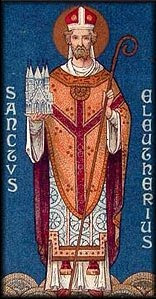
This saint is very popular in northern Europe, lived in a very difficult period in the history of France was probably born in 456 and died in 531. It is the time when the Gaul, and target several barbarian migrations, such as the Burgundes and that of the Visigoths - badly converted to Christianity, rising from idolatry to the Arian heresy - became a land of conquest of the Franks King Clovis. A conversion of these helped the Christian wife, Clotilde, venerated as a saint, the bishop of Reims, Saint Remigio and Saint Eleuterio, elected Bishop of Tournai in 484, when Clovis had made the city the capital of his kingdom, before to undertake the conquest of the Paris region. Although historically we do not possess any documents securely on the activity of this holy bishop and his missionary work, a biography attributed to St. Medard, contemporary and even a playmate in childhood, has many stories of life in San Eleuterio and their contacts with the pagan king Clovis. THE Medardo same predi...

Our Lady of Lourdes

Image
In 1858 the Virgin Mary appeared to Bernadette Soubirous near Lourdes in France within a cave of Massabielle. Through this humble girl, Mary called sinners to conversion enkindled within the Church a great zeal for prayer and charity, especially service to the sick and poor. here is a full story of OurLady of Lourdes... follow this link. http://www.medjugorjeusa.org/lourdes.htm Pray the rosary today

St. Volusian of Tours

Image
St. Volusian was born into a very wealthy family and was actually related to St. Perpetuus his predecessor as Bishops at Tours, presumably with Ruricius of Limoges. Only a little has been said about the time of his election as Bishop of Tours. Named bishop of the city in 488, he was forced to leave the see in 496 by the Arian Visigoths, and went to Spain. He died perhaps in Toulouse, or in Spain, possibly as a martyr. Very little is known about St. Volusian and I wasn't able to find a picture but here's one of the Cathedral in Tours PRAYER Lord may we venerate and apply the life of St. Volusian your humble servant of Tours, into our daily lives. That we may be humble of heart and Strong in our proclamation of the Gospel of Christ, who lives and reigns with you and the Holy Spirit forever and ever. AMEN .

St. Fursey

Image
Irish monastic founder, the brother of Sts. Foillan and Ulan, praised by St. Bede. Fursey was born on the island of Inisguia en Lough Carri, Ire­land, as a noble. He founded Rathmat Abbey, now probably Killursa. In 630 Fursey and his friends went to East Anglia, England, where he founded a monastery near Ugremouth on land donated by King Sigebert. In his later years, Fursey went to France to build a monastery at Lagny, near Paris, France. He was buried in Picardy. St. Bede and others wrote about Fursey’s intense ecstasies. Prayer of St. Fursey “The arms of God be around my shoulders, The touch of the Holy Spirit upon my head, The sign of Christ’s cross upon my forehead, The sound of the Holy Spirit in my ears, The fragrance of the Holy Spirit in my nostrils, The vision of heaven in my eyes, The conversation of heaven’s company on my lips, The work of God’s church with my hands, The service of God and my neighbour in my feet, A home for God in my heart, And to God, the father of all, my...

St. Cyrano

Image
Cyrano was an abbot of the seventh century. He lived in France in the seventh century and his life has told us and later told a biographer with many details and specifics. Berry was the son of noble. Eventually, he became bishop of Tours, the diocese most desirable of those times. He was educated in the city of Saint Martin. He was introduced in court to make a brilliant career. The father had even prepared a nice girl for marriage. One day, Cyrano left the court. Following the devotion to St. Martin of Tours became a hermit near his grave. Later, the clergy of the city welcomed him. Cyrano had given his entire estate to the poor the Gospel. Without anyone noticing, he left to join the bishop Tours Flavio, an Irishman who had a community of pilgrimage throughout Europe. Once in Rome, worked hard until they returned to France to found a monastery in the town of Longoret. This community grew under the guidance of St. Cyrano. That was a great austerity of life in all the monks. In other w...

St. Saturnin of Toulouse

Image
Born to the third century Roman nobility. Missionary to Gaul, the Pyrenees, and the Iberian peninsula. Worked with Saint Papoul. He converted many, including the farmer now known as Saint Honestus who joined him as a missionary. Imprisoned in Carcassone by the prefect Rufinus, Saturninus and his group were freed by an angel. He became the first bishop of Toulouse in modern France), where he teamed with Saint Martial to perform miraculous healings. Converted and baptized Saint Firminus of Amiens. When Saturninus began his work in Toulouse, the local pagan priests stopped receiving oracular messages from their gods. One day in 257, when the priests were hopelessly frustrated, Saturninus passed by in the street. The priests blamed the bishop, and ordered the crowd of heathens to seize him and force him to offer sacrifice to their gods. The idols fell to pieces in front of the bishop, and the crowd murdered him. PRAYER Lord you have given Saturnin the grace of entering into your eternal ki...

The Feast of Our Lady of the Miraculous Medal

Image
The Miraculous Medal was a medal invented by Saint Catherine of Labouré, after the Virgin Mary appeared to her. The virgin told her that times of evil were in France and in the world. On November 27 1830 Catherine reported the Virgin had appeared again in an oval frame, standing upon a globe, wearing many rings of different colors, most of which shone rays of light over the globe, and stepping on a head of a serpent. On the frame it said in Latin Ô Marie, conçue sans péché, priez pour nous qui avons recours à vous. Meaning in English O Mary, conceived without sin, pray for us who have recourse to thee. Catherine saw the frame rotate there was a cross with a letter M, surrounded by twelve stars, and had the Sacred Heart of Jesus and The Immaculate Heart of Mary. Catherine asked why some of the Virgin's rings were not shedding light.The Virgin said those were graces people forgot to ask for. The Virgin asked to take the image to the priest. So they can put on medallions so the people...

St. Martin of Tours

Image
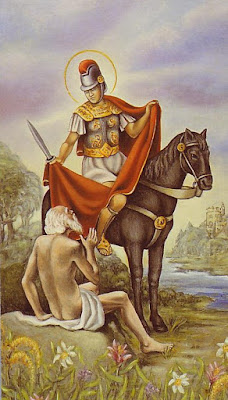
Martin was born in Savaria, Pannonia(which is now Hungary) in the year of 316. His father was part of the Roman Army, he was stationed in what is now Pavia, Italy; where Martin grew up. At the young age of 10 Martin went against his parents' wishes and enlisted in catechism to receive baptism. Since his father was a part of the Roman Army, at age 15 Martin had to enlist into the Calvary division. In the year 334 he was stationed in what is now Amiens, France. While in Amiens, Martin and his soldiers were making their way through the city, when they came to the gates he saw a beggar, at his Martin cut his cloak in half and gave the half to the beggar. That very same night Martin had a dream, in his dream he saw Jesus the half of the cloak he had given the man. Christ also said to his angels " This is Martin, a Roman soldier, who is not baptized but still comes to me." Also when Martin was asked why he had done that act of charity, he said " I have seen the face of Ch...