Posts

Showing posts with the label Deacon

St. Lawrence of Rome

Image
Lawrence was born in Huesca, Spain which is located in what is now known as Northern Aragon. Lawrence spent most of his life in Huesca and recieved religious guidance from local priests and deacons. Until he was brought to Rome by Pope Sixtus II, who at the time was the Archdeacon of Rome. When Sixtus was ordained Bishop of Rome, Pope, Lawrence was ordained a deacon in 257. Sixtus then stationed him as the first Archivist of the Catholic Church. And under his job he had to take care of the holiest chalice known to Christians everywhere, he was given the Holy Grail so he could keep it far away for the Persecution of Christians under Valerian was starting to heat up. Lawrence sent the Chalice away to Huesca with a letter to his parents to give it to a Monk who was a friend of Lawrence and the family. The Chalice was taken to the monastery where it remained hidden for centuries, and many believe that the Chalice is now in the Cathedral of Valencia. In the persecutions under Valerian in 25...

Pope St. Sixtus II

Image
Sixtus was born in Athens. As a deacon of the Roman church , succeeded Pope St. Stephen on the throne of St. Peter for 257 years , during the persecution of Valerian. Sixtus is a graduate of St. Cyprian: peaceful and excellent prelate . And actually a little peace it rushed away, she just was elected to the churches of Rome and Carthage in bitter fighting over the issue of baptism of heretics. (See St. Stephen I). He had a reconciliation with St. Cyprian , but there was no time for further dialogue , then faced a new emergency : Valerian unleashed a second persecution against Christians. They were invited to recant on pain of expropriation of property and decapitation. In late August of 258, St. Cyprian, who would be beheaded on September 14 he wrote to one of his colleagues : " Valerian , in a letter to the Senate, has ordered that bishops , priests and deacons be executed immediately. Before Pope Sixtus died it is said the he gave St. Lawrence of Rome the chalice the Jesus Chris...

St. Toribio Romo González

Image
Toribio was born April 16, 1900 in Santa Ana De Guadalupe, Jalostotitlán, Jalisco, Mexico. He was baptized April 18, 1900 two days after he was born. He was baptized by Fr. Miguel Diaz Orozco. In August of 1901 Toribio was confirmed by Francisco Campos Bishop of Tabasco. Toribio was part of a very religious family. In a special way his sister Maria took care of him and inspired Toribio to the Religious life of a Priest. When he was seven one Easter morning he received his First Holy Communion. When he was nine his parents let him go to Jalostotitlán where Toribo attended school named Escuela De Rayitos. In this time he was an altar server in the church of La Santisima Virgen De la Asuncion, who he prayed to all his life. When the bells rang for Mass at 6 AM Toribio accompanied by his sister; he assisted in the Holy Sacrifice of Mass, where Toribio borrowed his service as an altar server with great devotion. Before returning to school at night Toribio went to visited the blessed sacrame...

Ss. Faustinus and Jovita

Image
Faustinus and Jovita were brothers, nobly born and natives of Brescia. All the incidents in their reputed "Acts" are of doubtful authority, and we can only be sure of their names and martyrdom. According to the tradition of Brescia, they preached Christianity fearlessly while their bishop lay in hiding. Their zeal excited the fury of the heathens against them, then they were arrested by a heathen lord called Julian. They were tortured and dragged to Milan, Rome and Naples, and then brought back to Brescia. As neither threats nor torments could shake their constancy, the Emperor Hadrian, who happened to be passing through Brescia, commended them to be beheaded. The city of Brescia honors them as its chief patrons and claims to possess their relics. On April 18 the Roman Martyrology names the martyr St. Calocerus, who figures largely in the legendary history of St. Faustinus and Jovita, whose heroic confession he is said to have witnessed when, as a court official, he accompan...

St. Vincent of Saragossa

Image
Vincent was born third century AD Saragossa, Spain. Not much is known about his early life. But he was a deacon. He was taken prisoner for not denouncing his faith. He was thrown in jail. The prison guards made him starve. He refused to worship the pagan gods. He was tortured by being burnt on a grid iron. He burnt but he lived. They starved him even more. Until his martyrdom finally he was crucified in a cross shaped like an X. Vincent is the patron saint of wine growers,wine,vinegar makers, and Portugal. He is the protomartyr of Spain. Prayer Father may the martyrdom of saint Vincent help us understand that your name is holy we must defend with all our faith and strength. We ask this through Christ our Lord. AMEN

St. Stephen

Image
Stephen was born in the 1st Century in Jerusalem. Stephen is the very First Martyr in the Catholic Church, this is why he is referred to as a ProtoMartyr. Stephen's story is in Acts 6:5-15 and Acts 7:55-60. Stephen was chosen by the The Twelve (Peter, Andrew, John, James, James,Phillip, Bartholomew, Matthew, Thomas, Thaddeus, Simon and Barnabas.)to be another follower and proclaim the " good news " that was Christ. Since Peter was made the Bishop and later Pope by Christ, he and the Twelve decided to make St. Stephen a Deacon. Stephen is usually depicted in the Deacon's Dalmatic also with the stones at his head and with the Palm of the Martyr(as we see above). Later on in the Acts of the Apostles it mentions where St. Stephen had traveled to Acts 11:19-20. While they killed Stephen a young man named Saul of Tarsus who had approved of the killing later proclaimed a mass persicution of any Christians. To this many went into hiding but many were killed such as Stephen. T...

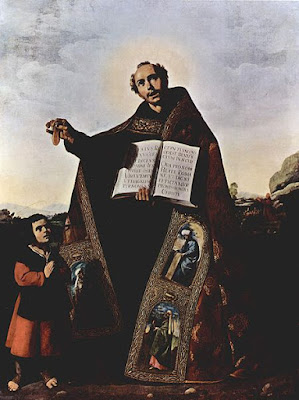
St. Romanus of Antioch

Image
Saint Romanus of Antioch is venerated as a martyr. In 303 at the beginning of the Diocletian persecution, a deacon called Romanus in Palestine suffered martyrdom at Antioch. He was taken prisoner, was condemned to death by fire, and was bound to the stake however, as the Emperor Galerius was then in Antioch. Romanus was brought before him. At the emperor's command Romanus' tongue was cut out. Tortured in various ways in prison he was finally strangled. Eusebius speaks of his martyrdom in De martyribus Palestin.Relates other details and gives Romanus a companion in martyrdom, a Christian by name Barulas. On this account several historians, among them Baronius, consider that there were two martyrs named Romanus at Antioch, though more likely there was but the one whom Eusebius mentions. Prudentius has introduced legendary features into his account, and his connection of the martyrdom of Barulas with that of Romanus is probably arbitrary. The feast day of St. Romanus is observed o...