Posts

Showing posts with the label Confessor

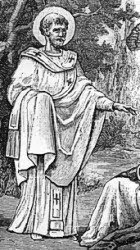
St. Frumentius

Image
Saint Frumentius was the first Bishop of Axum, and he is credited with bringing Christianity to Aksumite Kingdom. He was a Syro-Phoenician Greek born in Tyre. According to the 4th century historian Rufinus (x.9), who cites Frumentius' brother Edesius as his authority, as children (ca. 316) Frumentius and Edesius accompanied their uncle Meropius on a voyage to Ethiopia. When their ship stopped at one of the harbors of the Red Sea, people of the neighborhood massacred the whole crew, with the exception of the two boys, who were taken as slaves to the King of Axum. The two boys soon gained the favour of the king, who raised them to positions of trust, and shortly before his death, gave them their liberty. The widowed queen, however, prevailed upon them to remain at the court and assist her in the education of the young heir, Ezana, and in the administration of the kingdom during the prince's minority. They remained and (especially Frumentius) used their influence to spread Christi...
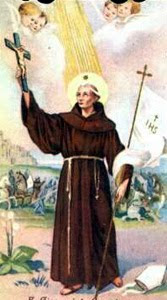
St. John of Capistrano

Image
Born in Capistrano, diocese of Sulmona, Italy, in 1385. The son of a French or German gentleman who died when John was young. Carefully studied at the University of Perugia (near Assisi). He was a lawyer and judge. In 1412 he was appointed governor of Perugia by Landislaus king of Naples, who had control of that city. He fought against corruption and bribery. When war broke out between Perugia and Malatesta in 1416, John tries to make peace, but instead was taken prisoner of war. In prison he decided to give himself entirely to God. Had a dream that San Francisco saw that he was called to enter the Franciscan order. John had married just before being taken prisoner, but the marriage never ate and was annulled. He entered the Franciscan order in Perugia on October 4, 1416. He was 30 years, so the novice tested it by giving the most humble offices. He was a disciple of St. Bernardino of Siena who taught him theology. He distinguished himself as a preacher while being a deacon. Ordained a...

St. Edward the Confessor

Image
Edward, St. Edward's grandson called the Martyr, was born in 1004 in Islip, near Oxford. His father was King Ethelred II, called the discouraged. While still a child, had to take the path of exile and lived from 1014 to 1041 in Normandy with relatives of his mother. It is said that vowed to go on pilgrimage to Rome if the Divine Providence led him back to his homeland. When this happened, Eduardo wanted to fulfill faithfully the vote, but the pope dispensed. The money you would spend on the trip gave to the poor and part of it was devoted to the restoration of the monastery in West London (West Minster, Westminster today.) Despite the political failures of their government, Edward King of England from 1043 to 1066, left a vivid memory in his hometown. The reasons for this devotion, which continued through the centuries, are to be found not only in some wise administrative measures such as the abolition of a heavy military duty that afflicted the entire nation but especially in its ...

St. Jerome

Image
The fourth century AD , which had its important moment in the 380 with the edict of Emperor Theodosius who ordered that the Christian faith had to be adopted by all peoples of the empire , is full of great figures of saints, Athanasius , Hilary, Ambrose, Augustine , Chrysostom , Basil and Jerome. The latter was born in Stridonia (Dalmatia ) around the year 340, he studied in Rome where he was baptized. His spirit is encyclopedic , his literary work reveals the philosopher, the orator , the grammarian , the dialectical , able to think and write in Latin, Greek, Hebrew writer, rich , pure and robust at the same time. He was responsible for the Latin translation of the Old and New Testament, which became, with the title of Vulgate, the official Bible of Christianity. Jerome is a personality very strong : everywhere where you raise enthusiasm or controversy. In Rome lashes the vices and hypocrisies and calls for new forms of religious life , attracting them to some influential women patric...

St. Raymond Nonnatus

Image
Born in the very beginning of the thirteenth century . Your name leaves gaping to anyone who hears or reads it first . Nonnatus - Nonnatus however brief , suggests a saint only potential , as if the word were an advertising slogan that was inviting to anyone who reads or hears it decided to start a program that would end the sanctity of the predetermined script . In fact , it means the unborn. " pretend that the strange name , was not born yet the saint who complete the full application of their qualities and virtues, is like expecting the Church to have one it decides when to reproduce ? That would , of course , to confuse holiness as something that springs from the will and human decision when she is actually the result of the action of the Holy Spirit who freely cooperates . It would simply Pelagianism. The term , which has already become -name Raymond comes to the fact that it was removed from the womb through surgery , when her mother died . Why was not born as children are b...

St. Louis IX of France

Image
He was born April 25, 1214 Poissy, France. During his second crusade, Louis died at Tunis, 25 August 1270, and was succeeded by his son, Philip III. Louis was traditionally believed to have died from bubonic plague but the cause is thought by modern scholars to have been dysentery. The Bubonic Plague did not strike Europe until 1348, so the likelihood of his contracting and ultimately dying from the Bubonic Plague was very slim. Christian tradition states that some of his entrails were buried directly on the spot in Tunisia, where a Tomb of Saint-Louis can still be visited today, whereas other parts of his entrails were sealed in an urn and placed in the Basilica of Monreale, Palermo, where they still remain. His corpse was taken, after a short stay at the Basilica of Saint Dominic in Bologna, to the French royal necropolis at Saint-Denis, resting in Lyon on the way. His tomb at Saint-Denis was a magnificent gilt brass monument designed in the late 14th century. It was melted down duri...

St. John Eudes

Image
John Eudes was born at Ri, Normandy, France, on November 14, 1601, the son of a farmer. He went to the Jesuit college at Caen when he was 14, and despite his parents' wish that he marry, joined the Congregation of the Oratory of France in 1623. He studied at Paris and at Aubervilliers, was ordained in 1625, and worked as a volunteer, caring for the victims of the plagues that struck Normandy in 1625 and 1631, and spent the next decade giving Missions, building a reputation as an outstanding preacher and confessor and for his opposition to Jansenism. He became interested in helping fallen women, and in 1641, with Madeleine Lamy, founded a refuge for them in Caen under the direction of the Visitandines. He resigned from the Oratorians in 1643 and founded the Congregation of Jesus and Mary (the Eudists) at Caen, composed of secular priests not bound by vows but dedicated to upgrading the clergy by establishing effective seminaries and to preaching missions. His foundation was opposed ...

St. Dominic de Guzmán

Image
The Dominicans are now celebrating. St. Dominic de Guzmán founded in the thirteenth century. For so many years have done and are doing a great service to the Church throughout the world. The founder of the Dominican fathers, who are now 6,800 in 680 houses in the world , was born in Caleruega , Spain, in 1171. His mother , Joan of Aza, was an admirable woman in virtues and has been declared Blessed . He was educated in strict religious training. At age 14 he went to live with an uncle, a priest in Palencia , in whose house he worked and studied. People said that age was a kid but that serious like an old man . His special joy was to read religious books, and give charity to the poor. At that time the region came a famine and people have begged for help to survive . St. Dominic de Guzmán distributed at home all I had and even furniture. Then, when he had nothing more to do to help the hungry, sold what he loved and appreciated , his books (at that time were copied by hand and very expen...

St. Alphonsus Maria de Liguori

Image
Bishop, Doctor of the Church, and the founder of the Redemptorist Congregation. He was born Alphonsus Marie Antony John Cosmos Damien Michael Gaspard de Liguori on September 27,1696, at Marianella, near Naples, Italy. Raised in a pious home, Alphonsus went on retreats with his father, Don Joseph, who was a naval officer and a captain of the Royal Galleys. Alphonsus was the oldest of seven children, raised by a devout mother of Spanish descent. Educated at the University of Naples, Alphonsus received his doctorate at the age of sixteen. By age nineteen he was practicing law, but he saw the transitory nature of the secular world, and after a brief time, retreated from the law courts and his fame. Visiting the local Hospital for Incurables on August 28, 1723, he had a vision and was told to consecrate his life solely to God. In response, Alphonsus dedicated himself to the religious life, even while suffering persecution from his family. He finally agreed to become a priest but to live at ...

St. Peter Chrysologus

Image
St. Peter , who was one of the most famous orators of the Catholic Church , was born in Imola , Italy and was formed by the Bishop of that city Cornelius, by which always retained a great veneration. Bishop Cornelio St. Peter convinced that in the domain of their own passions and lusts reject lies the true greatness, and that this is a sure way to get the blessings of God. St. Peter enjoyed the friendship of the Emperor Valentinian and his mother, Placida, and on the recommendation of the two, he was appointed archbishop of Ravenna. We also enjoyed the friendship of Pope Saint Leo the Great. When it became archbishop of Ravenna, had in this city a large number of pagans. And it worked so enthusiastically to convert them , that when he died and the pagans were very few non-believers in this place. A lot of people liked his sermons, and so gave him the nickname of Chrysologus , which means , that speaks very well. His manner of speech was concise , simple and practical. People were as...

St. Robert of Newminster

Image
Saint Robert was born in the district of Craven, near Skipton in North Yorkshire, probably in the village of Gargrave. He studied at the University of Paris, where he is said to have composed a commentary - since lost - on the Psalms. He became a parish priest, returning to serve in his hometown of Gargrave, where he was made rector. He later became a Benedictine at Whitby, joining a band of monks from Saint Mary's Abbey in York. They established a monastery in the winter of 1132 in a valley near Skeldale, on land given them by Archbishop Thurston. The first two years were difficult, and the monks struggled in extreme poverty. Initially they lived in a makeshift structure on the banks of the River Skell. But despite the hardships, the monks were known for their holiness, austerity, and dedication to the strict Benedictine way of life. Eventually, their fame brought a new novice, Hugh, Dean of York, who relinquished all his wealth to the community, and allowed for the building of mo...

St. Norbert Xanten

Image
Norbert was born in Xanten (Germany) of the noble family of Gennep, towards 1080. As was the custom for every second child of the nobility, Norbert will follow the race was for military or ecclesiastical. He chose the latter path, not by vocation, but by simple chance. In fact, being a deacon could enjoy the many privileges to the side of the Great Elector of Cologne and the emperor Henry V, which nominated for an important episcopal see. But God had other plans. During a ride through the forest, a violent hurricane that struck him down from his horse and, like Saul on the road to Damascus, said: "Lord, what can I do?". The response that radically changed his life unedifying was: "Abandon the path of evil and do good." That episode was the beginning of his conversion. Mundane places left and went to school in the Benedictine abbot of Siegburg and the canons of Klosterrath, then followed the example of the hermit Liudolfo spending three years in penance and prayer. I...

St. Francis Caracciolo

Image
The temporal environment in which God wanted put into the world is just as new winds blowing in the Church after the Council of Trent. It opens in the lush baroque art and piety to the foundations leading to new forms and styles to virgins who attempt to reform all that fought Trento. Languishing on Renaissance Rome drunk up to make it dull and unable to discover the evils brewing and exploded with Luther. That's why new saints time: Pius V, Charles Borromeo, Ignatius of Loyola, Juan de Ribera, Teresa of Ávila, John of the Cross, Francis of Sales, Philip Neri, Francis Cariacciolo ... and goals. Popes, poets, teachers, bishops, writers and apostles to a new time-India-grown seriously trying to return to prayer, to flee the luxurious, the confessionals, worship the Eucharist and preaching witnessing poverty with attention to destitute and sick. The year 1563 was interpreted by one of the biographers of Francis Caracciolo as an omen, was when the Council of Trent ends and is also the ...

St. Vincent Ferrer

Image
Vincent was born in Valencia (Spain) in 1350. At 17 he had already so successfully completed his studies in philosophy and theology that included teachers as faculty immediately. He entered the Dominican convent of Valencia and was ordained priest in 1375, a date in the history of the Church is remembered as the beginning of the Great Western Schism (1378-1417). The great confusion divided Christians into two obedience to Rome and Avignon. It was inevitable that even straight spirits, as Vincent Ferrer, of the pope were illegitimate. The good faith of Vincent Ferrer is tested with the fact that he has done everything possible to solve the great conflict and restore the unity of the Church. He traveled throughout Europe, warming to his great speaking to crowds of faithful, attracted also by a special phenomenon: the Dominican preacher, who only knew the Castilian, Latin and some Hebrew, "I understand all the faithful of the various nations where he went, each in their own language,...

St. Francis de Sales

Image
Born in Savoy in the heart of a Catholic family, a rarity in a region that Calvin had imposed his doctrine of predestination against the odds. His father wanted to study law and sent him to Paris. But it was here that he felt love for theology and the problems of predestination. The pernicious Calvinistic doctrine had penetrated into himself for moments. It was believed destined for damnation. In this state of crisis, read something that turned him completely. It was a prayer of St. Bernard. He gave a course of 180 degrees to your life. He was full of joy, giving life to all its rich pastoral bishop of Geneva. He also began his writing with "Introduction to the Devout Life." He stayed and lived near Geneva, in Annecy, not to be bothered with headquarters and the emporium of the Calvinists. He devoted himself to making contact with the Catholics of his time, helped all he could to bring it to fruition the reform of Caramel and the very foundation of the Oratory, founded by St....

St. John Cantius

Image
Born at Kenty, near Oswiecim, Diocese of Krakow, Poland, 1412 died at Krakow, 1473, and was buried there under the church of St. Anne; his feast is on 20 October. He was the son of Stanislaus and Anne who were pious country people; he received his primary education at his native town, and then being sent by his parents to the Academy of Krakow, he soon impressed his professors and colleagues with his pleasant and amiable disposition; always happy, but serious, humble, and godly, he won the hearts of all who came in contact with him. Having made excellent progress in the study of philosophical and theological sciences, he was graduated first as bachelor, then as master and doctor, was ordained priest and then appointed professor of theology at the Academy of Krakow, from where he was sent, after a short time, by his superiors to Olkusz, Diocese of Krakow, to be parish priest. Being afraid of the great responsibility of parish work, he very soon left the parish, and was again appointed p...

St. Anastasius I

Image
Nation was Roman, his father was called Maximus. He was elected Pope Gratian prevail, and it happened in the Apostolic San Sericius in December 398. He had the high priesthood three years, ten months and twenty days. Was that priests were not seated, but standing and leaning when Evagelia read or sing in the church, and that no pilgrim was largely if Transmarine, was admitted into the clergy if he brought no witness who was sealed and signed by five bishops. This ordered by the Manichean, which then were much esteemed in Africa, and to corrupt Catholics sent many of their people to various parts where they could plant their heresies. Was also weak or crippled, or any others that lacked any member, were not clerics. Consecrated the church in the region called Crescentina second in via Mamertine. Held twice orders for the month of December, and ordered them to 8 priests, 5 deacons and 10 bishops, and having served the Lord faithfully (because the world was not worthy of enjoying long tim...

St. Eligius

Image
The son of Eucherius and Terrigia seems that since the beginning of its existence was under the sign of divine predilection. So says the legend of his life. Awake intelligence and skillful in using their hands. Apprentice silversmith of before, that is, those who have to hammer the metal to get him out of the bowels the figure that the artist has in mind. Acquired such skill that King Clotaire II, Dagobert then his son and grandson Clovis II then held him as himself in court for work in precious metals naturally need the blue blood who live in palaces and have to solve social commitments , political and even military with their peers. But what attracted wide attention of these major Gallic country was not only his art. That was the starting point. Then it was the discovery of his entire personality deeply honored. A real man. Right-minded. Cristiano works more than name only. Pious and consistent in their loneliness in life. Cautious words and weighted at the trials. A rare subject in ...

St. Alphonsus Rodriguez

Image
Confessor and Lay brother, also called Alonso. He was born in Segovia, Spain, on July 25, 1532, the son of a wealthy merchant, and was prepared for First Communion by Blessed Peter Fabre, a friend of Alphonsus' father. While studying with the Jesuits at Alcala, Alphonsus had to return home when his father died. In Segovia he took over the family business, was married, and had a son. That son died, as did two other children and then his wife. Alphonsus sold his business and applied to the Jesuits. His lack of education and his poor health, undermined by his austerities, made him less than desirable as a candidate for the religious life, but he was accepted as a lay brother by the Jesuits on January 31, 1571. He underwent novitiate training and was sent to Montesion College on the island of Majorca. There he labored as a hall porter for twenty-four years. Overlooked by some of the Jesuits in the house, Alphonsus exerted a wondrous influence on many. Not only the young students, such ...